

The way businesses interact with customers has changed significantly with the growth of digital technology. From online shopping platforms and banking applications to educational portals and booking systems, web applications have become an essential part of everyday life. Building these applications requires technologies that are flexible, efficient and scalable.
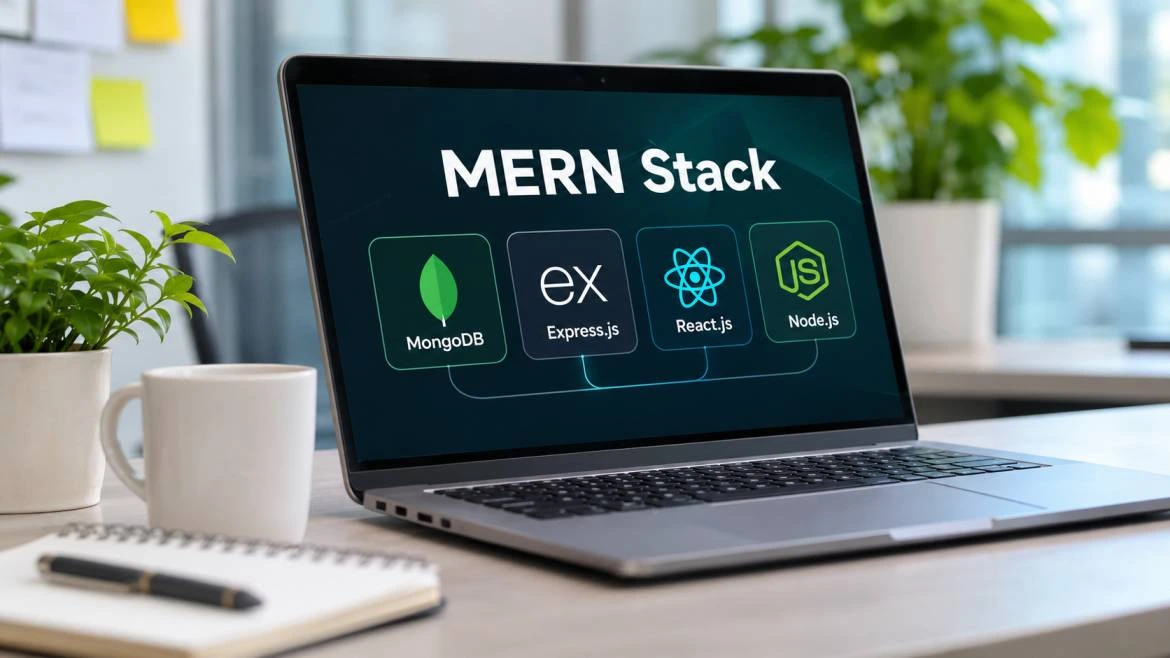
MERN Stack is one of the popular technology combinations used in modern web development. It brings together four powerful technologies: MongoDB, Express.js, React.js and Node.js. These technologies allow developers to build complete web applications using JavaScript across both frontend and backend development.
Understanding MERN Stack is an important step for developers who want to create interactive websites and dynamic applications.
What Is MERN Stack?
MERN Stack is a full-stack JavaScript technology stack consisting of four components:
- MongoDB: A NoSQL database used to store application data.
- Express.js: A backend framework used to develop APIs and manage server-side operations.
- React.js: A JavaScript library used to create interactive user interfaces.
- Node.js: A JavaScript runtime environment used to execute JavaScript on the server.
Each technology performs a specific role, but they work together to create a complete web application.
One of the major advantages of MERN Stack is that developers can use JavaScript throughout the development process, reducing the need to switch between different programming languages.
Understanding the Four Technologies
MongoDB – Managing Application Data
MongoDB is a document-oriented NoSQL database that stores information in flexible BSON documents. Unlike traditional relational databases, it does not require a fixed table structure.
For example, an e-commerce application may store customer information in MongoDB.
{
name: “John”,
email: “[email protected]”,
city: “Kochi”,
purchasedProducts: [“Laptop”, “Mobile”]
}
MongoDB makes it easier to manage different types of application data and supports flexible data structures.
Express.js – Developing Backend APIs
Express.js is a lightweight framework built on Node.js. It simplifies backend development by providing routing, middleware and request-handling functionality.
Developers use Express.js to create APIs that connect the frontend with backend services.
Example:
const express = require(“express”);
const app = express();
app.use(express.json());
app.get(“/api/users”, (req, res) => {
res.json({
message: “Users fetched successfully”
});
});
app.listen(5000, () => {
console.log(“Server running on port 5000”);
});
In this example, Express.js creates an API endpoint that returns a JSON response when a user requests the /api/users route.
React.js – Building Interactive User Interfaces
React.js is a JavaScript library developed for building user interfaces. It uses reusable components, making applications easier to develop and maintain.
For example, an online shopping application may contain components such as:
- Navbar
- Product List
- Product Card
- Shopping Cart
- Login Form
Example:
function Product() {
return (
<div>
<h2>Wireless Headphones</h2>
<p>Price: ₹2,500</p>
<button>Add to Cart</button>
</div>
);
}
export default Product;
This component displays a product name, price and button. Developers can reuse similar components throughout an application.
Node.js – Running JavaScript on the Server
Node.js is an open-source JavaScript runtime environment that allows JavaScript code to execute outside a web browser.
It uses an event-driven, non-blocking I/O model, making it suitable for developing scalable network applications.
Node.js works with Express.js to process client requests, execute backend logic and communicate with databases.
How Does MERN Stack Work Together?
Consider an online shopping application where a customer searches for a product.
The application follows a sequence of operations:
Step 1 – User Interaction: The customer enters a product name in the React.js interface.
Step 2 – API Request: React sends an HTTP request to the backend API.
Step 3 – Backend Processing: Express.js receives the request, and Node.js executes the required application logic.
Step 4 – Database Communication: The backend communicates with MongoDB to retrieve matching products.
Step 5 – API Response: The backend sends the product information to React in JSON format.
Step 6 – Display Results: React updates the interface and displays the products to the customer.
This communication process allows users to interact with applications without manually refreshing the entire page.
Understanding MERN Stack Architecture
A typical MERN Stack application follows a three-layer architecture.
Presentation Layer: React.js manages the frontend interface, user interactions and application display.
Application Layer: Node.js and Express.js handle business logic, API requests, authentication and backend operations.
Data Layer: MongoDB stores and manages application information, including customer details, products and transactions.
These layers communicate with each other through API requests and responses. Separating responsibilities makes the application easier to maintain, test and expand.
Real-World Applications of MERN Stack
MERN Stack can be used to develop various types of web applications.
Some common examples include:
- E-commerce Applications: Product listings, shopping carts, customer accounts and order management.
- Job Portals: Jobseeker registration, recruiter dashboards, job postings and application tracking.
- Learning Management Systems: Course management, student registration and learning progress tracking.
- Booking Platforms: Appointment scheduling, service selection and booking management.
- Social Networking Applications: User profiles, posts, comments and interactive features.
- Business Dashboards: Data management, reports and administrative operations.
These applications demonstrate how MERN Stack can support different business requirements.
Advantages of MERN Stack Development
MERN Stack offers several benefits for developers and organisations.
JavaScript Across the Stack: Developers can use JavaScript for frontend and backend development.
Reusable Components: React.js supports reusable components, helping reduce code duplication.
Flexible Data Management: MongoDB provides a document-based structure suitable for changing application requirements.
Efficient API Development: Express.js simplifies backend routing and request handling.
Open-Source Technologies: All four technologies are supported by large developer communities and extensive documentation.
Scalability: Applications can be designed and optimised to support increasing users and business requirements.
Essential Skills for a MERN Stack Developer
Developing a complete MERN Stack application requires more than understanding the four technologies. Developers should also gain practical knowledge of:
- HTML5 and CSS3 for website structure and styling.
- JavaScript fundamentals and ES6+ features.
- React.js, Hooks and component-based development.
- Node.js and Express.js for backend development.
- MongoDB and Mongoose for database operations.
- REST API development and integration.
- Authentication and authorisation.
- Git and GitHub for version control.
- Testing, debugging and application deployment.
Working on practical projects helps developers understand how these technologies function together in real-world applications.
Conclusion
MERN Stack has become an important technology combination in modern web development. By bringing together MongoDB, Express.js, React.js and Node.js, developers can build dynamic and database-driven applications using a unified JavaScript ecosystem.
From e-commerce platforms to job portals and business management systems, MERN Stack provides the flexibility and tools required to develop modern web solutions.
As web technologies continue to evolve, understanding full-stack development concepts and gaining hands-on experience will remain valuable for aspiring developers.
Building a strong foundation in MERN Stack is a meaningful step towards creating innovative web applications and developing a career in the software industry.
Keep learning, keep building and explore the possibilities of modern web development with ObsquraZone.
Obsqura Zone — Transforming Lives in IT.


